
Spring/Summer 2027 Fashion Trends: What Milan Fashion Week Means for the High Street


New York gave us bold color, London brought rebellious attitude — and now Milan has spoken.
And if there is one word I would use to describe Milan's Spring/Summer 2027 collections, it would be refined.
But this wasn't quiet, minimalist refinement.
Milan brought us sensuality, craftsmanship, statement skirts, lingerie-inspired dressing, animal print, relaxed tailoring, longer hemlines, and plenty of Italian glamour.
A strong sense of practicality also ran through many of the collections. Utility pieces were elevated, tailoring softened, and summer dressing was designed to feel luxurious without being complicated.
Prada put the skirt at the center of its entire collection, while Fendi and Etro explored lingerie-inspired dressing. Gucci mixed polished bourgeois references with a more rebellious edge, and Bottega Veneta focused on lightness, craftsmanship and the transition into summer.
So what does all of this mean for the high street?
As with New York and London, the runway isn't a shopping list.
The interesting part is identifying which ideas are likely to filter down into the clothes we actually see in stores—and how personal stylists might interpret those trends for real clients.
Let's take a look.
1. The skirt takes center stage
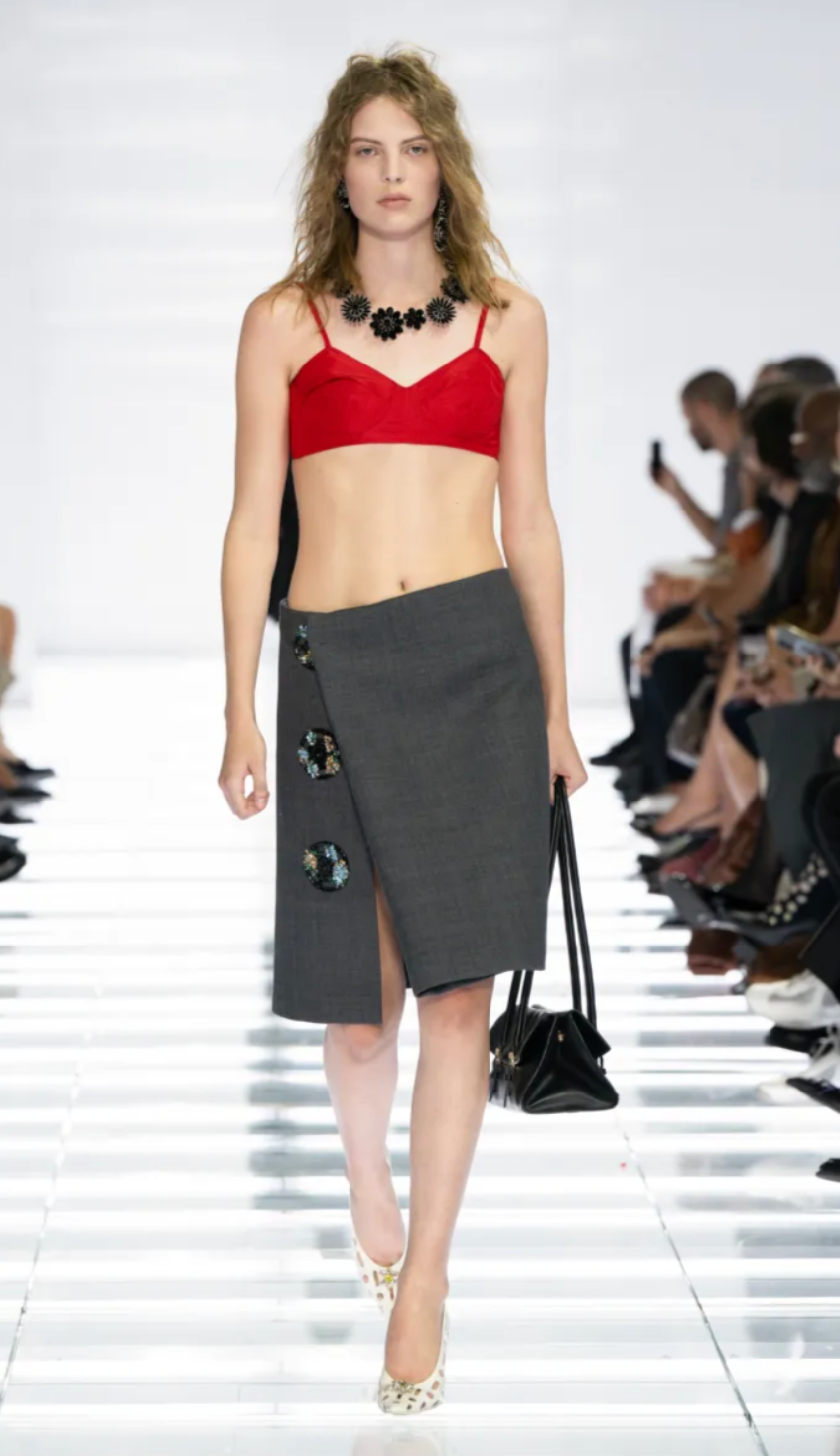
If one garment dominated Milan Fashion Week, it was the skirt.
And Prada didn't just include a lot of skirts.
The entire Spring/Summer 2027 collection was built around them.
Miuccia Prada and Raf Simons sent 63 looks down the runway — every one featuring a skirt. There were knee-length skirts, minis, pleated styles, embellished versions, sheer layers, and more experimental constructions.
What makes the Prada collection particularly interesting is the way the skirt was treated as a foundation rather than an afterthought.
A skirt could be worn with a sweater.
A shirt.
A bra top.
A raincoat.
Or something much more unexpected.
And that idea appeared elsewhere across Milan too.
What could this mean for the high street?
Expect skirts to become much more visible in Spring/Summer 2027 collections, particularly:
Knee-length skirts
Pleated skirts
A-line skirts
Sheer skirts
Embellished skirts
Longer, flowing styles
More casual skirts paired with everyday tops
This could be particularly significant after several years in which trousers — especially wide-leg trousers and denim — have dominated everyday wardrobes.
The skirt is coming back as a wardrobe foundation.
The stylist's takeaway
The exciting thing about a skirt is its versatility.
The same skirt can look completely different depending on what you put with it.
A pleated skirt with sneakers feels very different from the same skirt with heels.
A pencil skirt with a sweater creates a different image from one worn with a lingerie-inspired top.
So don't think of this trend simply as:
“Skirts are back.”
Think:
“The skirt is becoming a new starting point for styling.”
Runway examples: Prada, Luisa Beccaria, Fendi

2. The bra becomes the top
We've already seen lingerie-inspired dressing emerging in New York and London.
Milan took the idea and made it one of the season's clearest fashion statements.
At Prada, minimal balconette-style bras were paired with the collection's many skirts.
Fendi explored boudoir-inspired dressing through satin bralettes and lingerie details, while Etro styled bralette shapes with tailoring, jewelry, and more traditional wardrobe pieces.
This is an important distinction.
The trend isn't necessarily:
“Go outside wearing your underwear.”
It's about the bra becoming an intentional visible part of the outfit.
That could mean a bra worn under an open jacket, a lace-trimmed bralette paired with a high-waisted skirt, or a lingerie-inspired camisole that creates the same visual effect in a more accessible way.
What could this mean for the high street?
Expect lingerie influences to appear through:
Lace-trimmed camisoles
Satin bralettes
Visible bra details
Corset-inspired tops
Lace panels
Bustier shapes
Underwear-inspired eveningwear
For many consumers, the high-street version will inevitably be more wearable than the runway interpretation.
And that's a good thing.
The stylist's takeaway
This trend is a perfect example of why styling is about interpretation, not imitation.
Not every client will want to expose a bra.
But perhaps she would love a lace-trimmed camisole beneath a blazer.
Or a structured bustier with high-waisted trousers.
The fashion direction can remain the same while the level of exposure changes completely.
3. Animal print gets wilder
Animal print is back for Spring/Summer 2027 — but Milan isn't interested in keeping it subtle.
Leopard appeared across the collections, while designers also experimented with reptile-inspired motifs and combinations of different animal patterns.
Dolce & Gabbana used leopard across tailoring and eveningwear, while Fendi explored reptile-inspired patterns through accessories. Roberto Cavalli, unsurprisingly, embraced the trend's more maximalist side, mixing animal motifs with contrasting prints and textures.
This isn't necessarily about wearing head-to-toe leopard.
Instead, expect animal print to appear as:
Skirts
Dresses
Jackets
Shoes
Bags
Belts
Scarves
Statement accessories
What could this mean for the high street?
Animal print is easy for retailers to translate commercially.
And because it can be used in small doses, it's accessible to a much wider audience than some more dramatic runway trends.
A leopard-print shoe can completely change a neutral outfit.
So can a belt.
Or a handbag.
Or a skirt worn with a simple white shirt.
The stylist's takeaway
Animal print is effectively functioning as a neutral.
That means it can be treated as a pattern that works alongside other colors and textures rather than something that needs to be isolated.
But scale matters.
So does contrast.
And so does the client's overall visual presence.
Runway examples: Fendi, Dolce & Gabbana, Roberto Cavalli

4. Tailoring gets softer
Milan isn't abandoning tailoring.
It's simply making it easier.
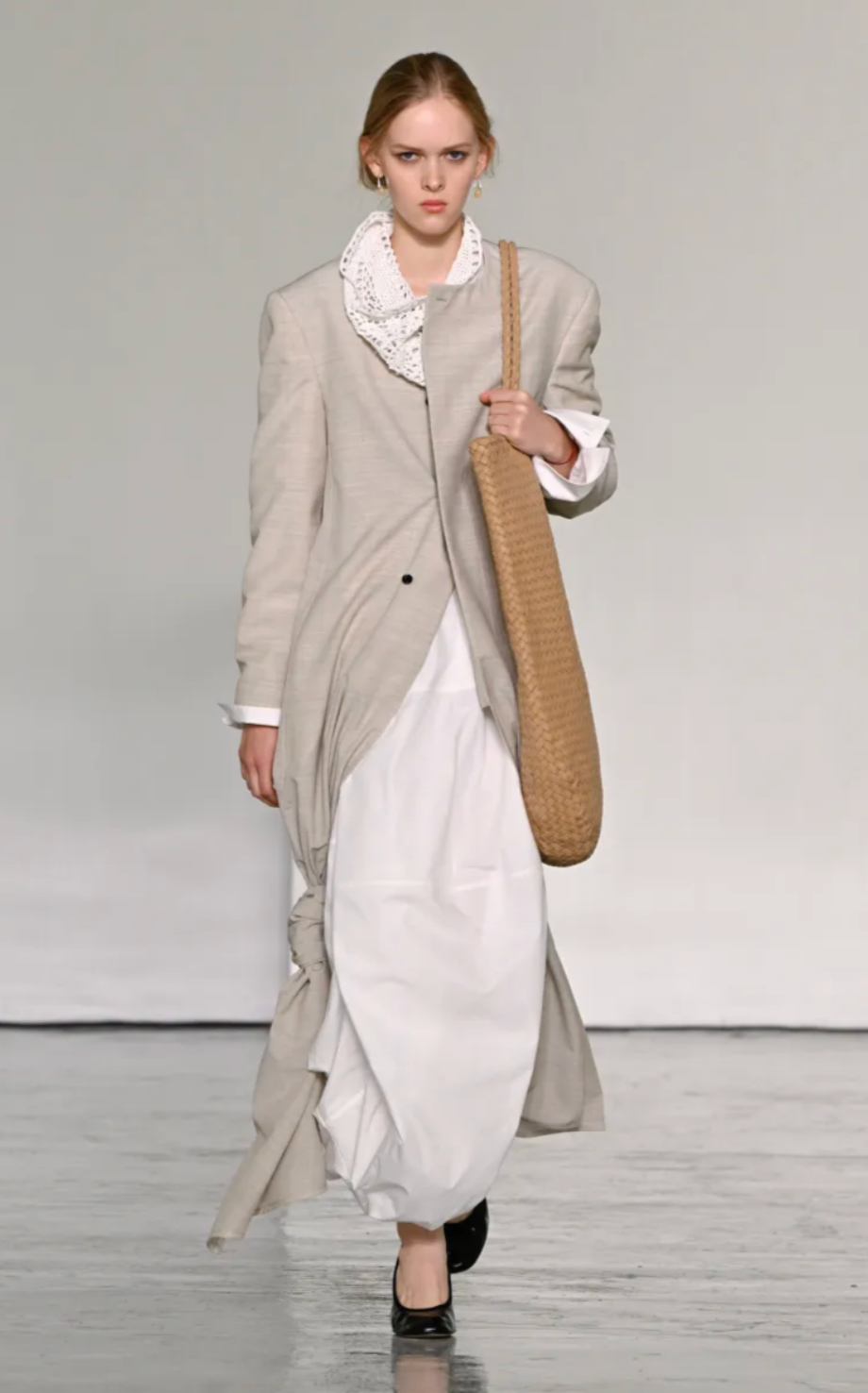
Across the collections, traditional tailoring was relaxed through larger proportions, fluid fabrics, wide-leg trousers and softer construction.
At Jil Sander, tailoring took on cocoon-like proportions.
At Tod's, roomy blazers were paired with wide-leg trousers.
And Max Mara created what it called “utility luxe,” combining tailored pieces with safari jackets, cargo-inspired garments, gilets and practical details.
The result is tailoring that feels polished without feeling overly formal.
What could this mean for the high street?
Expect:
Oversized blazers
Wide-leg trousers
Relaxed suits
Soft tailoring
Longline jackets
Utility-inspired tailoring
Tailored separates rather than matching suits
This is particularly useful for consumers who want to look polished but don't necessarily want to look corporate.
The stylist's takeaway
This trend is all about proportion.
An oversized blazer doesn't automatically create a flattering or polished outfit.
What matters is what happens elsewhere.
A voluminous jacket might work beautifully with a slimmer skirt.
A wide-leg trouser might need a more fitted top.
Or the entire look might deliberately embrace volume.
The key is making the proportions look intentional.
Runway examples: Jil Sander, Tod's, Max Mara

5. Longer hemlines are moving back into focus
While shorter silhouettes haven't disappeared, Milan is giving longer hemlines a serious moment.
Prada focused heavily on knee-length skirts.
Luisa Beccaria took the idea in a more romantic direction with sweeping, floor-length floral dresses.
And across other collections, longer skirts and dresses created a sense of elegance and movement.
This is an interesting development because it gives consumers an alternative to the micro-mini and shorter silhouettes that have dominated recent seasons.
What could this mean for the high street?
Look out for:
Knee-length skirts
Midi skirts
Maxi skirts
Long dresses
Elongated tailoring
Longer coats and lightweight outerwear
The midi length in particular is likely to become a useful commercial bridge between the shorter and longer extremes.
The stylist's takeaway
The hemline is one of the simplest ways to change an outfit's visual proportion.
So rather than thinking about whether a particular length is “flattering,” consider the relationship between the hemline, the rest of the outfit, and the client's intended image.
A long skirt can feel elegant.
It can feel bohemian.
It can feel minimalist.
It can feel dramatic.
It's the styling that determines the result.
Runway examples: Prada, Luisa Beccaria, Bottega Veneta
6. The summer cover-up becomes a statement
Who says summer means leaving the outer layer at home?
Milan designers are making the cover-up an important part of the outfit.
At Etro, oversized embellished jackets added impact to lighter summer looks.
Gucci gave the leather jacket a more voluminous treatment, while Bottega Veneta used belted outerwear and lightweight materials to create a more elongated summer layer.
This is particularly interesting because summer dressing is often treated as an exercise in removing layers.
Milan is suggesting something different:
The layer can be the outfit.
What could this mean for the high street?
Expect lightweight statement layers such as:
Oversized jackets
Lightweight leather
Embellished jackets
Longline outerwear
Utility jackets
Belted jackets
Lightweight trenches
This trend is also easy to adapt to unpredictable summer weather.
The stylist's takeaway
A statement layer can completely change an outfit underneath.
That makes it an incredibly useful styling tool.
A simple jeans-and-T-shirt combination can become much more sophisticated with the right jacket.
And because the outer layer creates such a strong visual impression, it can also be a particularly effective way to communicate personality.
Runway examples: Etro, Gucci, Bottega Veneta

7. Lightweight craftsmanship
Milan is famous for craftsmanship, and Spring/Summer 2027 showed that this doesn't have to mean heavy, elaborate clothing.
At Bottega Veneta, Louise Trotter explored a lighter approach to the house's craft traditions, using crochet, webbed fabrics, lightweight silk, and leather manipulated to resemble raffia.
Dolce & Gabbana also incorporated crochet and doily-like techniques into dresses, while other collections explored intricate embroidery and artisanal details.
This gives Spring/Summer 2027 a more tactile edge.
What could this mean for the high street?
Expect to see:
Crochet
Open-weave knitwear
Raffia-inspired textures
Embroidery
Lace
Handmade-looking details
Textured bags
Decorative trims
These details can make simple silhouettes feel much more special.
The stylist's takeaway
Texture is an often-overlooked part of styling.
A neutral outfit doesn't have to rely on color to create visual interest.
You can create it through texture, surface, and fabrication.
Think smooth silk against rough crochet.
Leather against lace.
Matte cotton against something glossy.
That's where a simple outfit can become much more interesting.
Runway examples: Bottega Veneta, Dolce & Gabbana, Fendi

8. The art of mixing
If New York gave us printmaxxing and London encouraged unexpected combinations, Milan is adding its own version of more-is-more dressing.
The emphasis is less on matching everything perfectly and more on making contrasting elements work together.
Dhruv Kapoor mixed patchworked florals, checks and graphic motifs.
Moschino played with bold color combinations, while other Milan collections combined contrasting textures, proportions and references.
This is fashion that doesn't necessarily want everything to coordinate.
And that's refreshing.
What could this mean for the high street?
Expect to see more opportunities for consumers to combine:
Prints
Colors
Textures
Feminine and masculine pieces
Sporty and polished pieces
Vintage and contemporary references
The high street may not reproduce the most extreme runway combinations, but individual pieces will make this trend easy to recreate.
The stylist's takeaway
Mixing doesn't mean throwing random things together.
There needs to be a connection.
It could be color.
It could be scale.
It could be texture.
It could be silhouette.
Or it could simply be a shared visual language.
The skill is understanding why two seemingly unrelated pieces work together.
Runway examples: Dhruv Kapoor, Moschino, Marni

9. Accessories become the statement
Accessories have been important throughout Spring/Summer 2027, but Milan is giving them particular emphasis.
At Fendi, vivid Baguette bags were embellished with sequins and fringe.
Marni used bold, geometric earrings and highly expressive accessories.
And across Milan street style, statement bags, unusual shoes, and bold accessories were doing much of the visual work.
This trend should translate extremely well to the high street.
Why?
Because accessories allow consumers to experiment without rebuilding their wardrobes.
What could this mean for the high street?
Look out for:
Statement earrings
Embellished bags
Fringed bags
Sculptural shoes
Colorful handbags
Oversized belts
Statement sunglasses
Decorative accessories
And because accessories are often less expensive than clothing, this could be one of the fastest Milan trends to reach mainstream stores.
The stylist's takeaway
Accessories can be more than finishing touches.
They can be image-defining pieces.
A simple black outfit with a dramatic handbag communicates something very different from the same outfit with minimalist accessories.
The accessory can introduce color, texture, personality, or even a completely different style direction.
That's why understanding accessories is such an important part of personal styling.
Runway examples: Fendi, Marni, Bottega Veneta

So, what can we actually expect to see on the high street?
Milan has given us a slightly different shopping list from New York and London.
If I were looking ahead to Spring/Summer 2027, I'd be watching for:
More skirts
Particularly knee-length, pleated, A-line, midi and maxi styles.
Lingerie-inspired pieces
Bras, bustiers, lace and satin becoming more visible.
Animal print
Especially leopard, reptile-inspired patterns and more experimental combinations.
Relaxed tailoring
Softer suits, wide-leg trousers and oversized jackets.
Longer silhouettes
Midi and maxi lengths becoming increasingly important.
Statement outerwear
Lightweight jackets and cover-ups becoming central to summer outfits.
Craft-inspired textures
Crochet, lace, embroidery, raffia-like textures and artisanal details.
Unexpected combinations
More mixing of color, print, texture and contrasting style references.
Statement accessories
Bags, jewelry and shoes doing more of the talking.
And there is an interesting common thread running through all of these trends.
Milan is making everyday dressing feel more considered.
The bigger Milan trend: polished individuality
New York has given us experimentation.
London has given us attitude.
Milan has given us polish.
But it isn't the overly perfect, highly controlled kind of polish we've seen associated with minimalism and quiet luxury.
Instead, Milan is combining sophistication with personality.
A modest skirt can be worn with a bra top.
A tailored jacket can be oversized.
A utility vest can become luxury clothing.
A leopard print can be paired with tailoring.
A simple skirt can become the foundation for an entire wardrobe.
And an accessory can completely change the personality of an outfit.
That's what makes Milan's SS27 collections particularly interesting for personal stylists.
The message isn't:
“This is how you should dress.”
It's:
“Take familiar wardrobe pieces and rethink how you use them.”
The stylist's job isn't to recreate Milan
This is becoming a recurring theme as we move through fashion month — and I think that's important.
A runway trend is information.
It's not an instruction.
If skirts are everywhere, that doesn't mean every client needs a skirt.
If lingerie dressing is trending, that doesn't mean every client needs to expose a bra.
If animal print is back, that doesn't mean everyone needs a leopard coat.
The stylist's role is to understand the principle behind the trend and then decide whether, where, and how it could work for the individual.
Maybe the client doesn't want a bra top.
But she loves the idea of a lace-trimmed camisole.
Maybe she doesn't want head-to-toe animal print.
But a leopard shoe would be perfect.
Maybe she isn't comfortable in an oversized suit.
But a softer, relaxed blazer could transform her wardrobe.
That's the difference between following fashion and understanding style.
The runway gives us the direction.
The stylist translates it.
New York, London and Milan: three very different takes on Spring/Summer 2027
Now that we've reached the end of Milan Fashion Week, the SS27 fashion story is becoming much clearer.
New York brought bold color, print mixing, fringe, relaxed tailoring, and joyful maximalism.
London added indie-rock attitude, sheer dressing, sporty pieces, British heritage, romance and deliberately undone styling.
Milan has brought skirts, lingerie-inspired dressing, animal print, relaxed luxury, longer silhouettes, craftsmanship and statement accessories.
Yet common threads run through all three cities.
Individuality.
Unexpected combinations.
More expressive styling.
A willingness to mix polished pieces with more relaxed or rebellious elements.
And perhaps most importantly, a move away from the idea that there is one “correct” way to dress.
That's good news for personal stylists.
Because the more varied fashion becomes, the more important individual interpretation becomes.
What comes next?
With New York, London and Milan now complete, all eyes turn to Paris.
And that's where the Spring/Summer 2027 story will get its final major chapter.
Will Paris reinforce the themes we've already seen?
Or will it introduce something completely different?
Either way, one thing is becoming clear.
Spring/Summer 2027 isn't going to be about simply buying the latest trend.
It's going to be about how you put the pieces together.
And for personal stylists, that's where the real opportunity lies.
Fashion gives us the trends.
Style is knowing what to do with them.
Happy Styling!
Louisa 💕